
Arizona, lower basin states unveil Colorado River plan to save Lake Mead
Arizona, California and Nevada have struck a Colorado River deal to conserve 3.2 million acre-feet over two years and slow Lake Mead's decline.

Watch: Lower basin states propose plan to conserve 3.2 million acre feet over 2 years | 1 min
Arizona, California and Nevada, the three Lower Basin states, have struck a deal to conserve 3.2 million acre-feet of Colorado River water over the next two years.
It’s no fix for the water crisis, but it buys the basin more time to hammer out a long-term solution with the other states.
“The river really is tanking after a dismal winter (with) the seven U.S. states at a complete deadlock on negotiations,” Chris Kuzdas, Arizona water program director for the nonprofit Environmental Defense Fund, told KTAR News 92.3 FM.
Arizona is committing to a 27% mandatory reduction of its Colorado River supply, about 10% of the state’s total annual water use.
“That’s a really big accomplishment for a Southwestern state,” Kuzdas said.
States, feds split conservation costs
The proposal also splits the cost of conservation between the federal government and the states.
Any water the U.S. Bureau of Reclamation buys through the program would be paid for jointly, either through in-kind contributions, discounted pricing compared to past federal programs, or direct funding from the states.
Meanwhile, Arizona Governor Katie Hobbs has proposed a Colorado River Protection Fund in her version of the state budget, which is part of ongoing budget battle with Republican lawmakers.
“Funded, at least in part potentially, through new revenue on water-use assessments with data centers,” Kuzdas said.
He said the permanent revenue source would help the state navigate the near-term crisis on the Colorado River and build low water-use economies needed for the long term.
‘Worst-case scenario’ looms at Glen Canyon Dam
The plan also takes steps to address low water levels behind Glen Canyon Dam, which generates hydropower and releases water from Lake Powell downstream to Lake Mead.
“Once water cannot get through the turbines, then we’re unsure how long water can pass through the river outlet works without those actually potentially collapsing,” Kuzdas said.
Under the proposal, the Department of the Interior would publish a plan by the end of 2027 to address long-term operational and structural risks at the dam, with implementation beginning no later than the end of 2028.
“That is a worst-case scenario because if we can’t get water past Glen Canyon Dam, that means the Colorado River as we know it through the Grand Canyon has collapsed,” Kuzdas said.
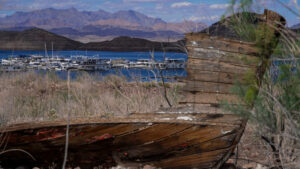
Downstream at Lake Mead, currently sitting at 1,052 feet, the proposal sets a separate trigger.
If Lake Mead is projected to drop below 1,010 feet, federal officials will work with the three Lower Basin states to decide what — if anything — needs to be done to keep levels from sinking another 35 feet to 975.
Tribes get their own water pool under proposal
The proposal looks to create a first-of-its-kind “Tribal Pool,” a way to ensure the federal government meets its obligations to the 22 American Indian tribes in Arizona entitled to their share of water.
“The Tribal Pool will be primarily a federal responsibility,” explains the report. “Arizona tribes will also contribute water to the Tribal Pool at discounted prices.”
Lower division state, like Arizona, will not contribute to the Tribal Pool.
Ultimately, Kuzdas warned, all seven basin states, Arizona among them, will have to face the reality of permanent water cuts.
Related
 Arizona, California, Nevada announce temporary plan to cut Colorado River water use
 Lake Powell, a Colorado River reservoir, needs infusion to maintain power generation
 Could Arizona communities share water during shortages? Phoenix is taking the first step
 Arizona university researchers study how to increase shrinking groundwater supplies
 How did last year’s Dragon Bravo Fire impact Grand Canyon water supply?
 Amid other struggles, Arizona farmers brace for more Colorado River water cuts

Comments