
While other Arizona COVID metrics improve, rate of deaths remains stubborn
While most of Arizona’s pandemic metrics have been heading in the right direction, the state hasn’t yet seen a sustained decline in deaths from COVID-19.

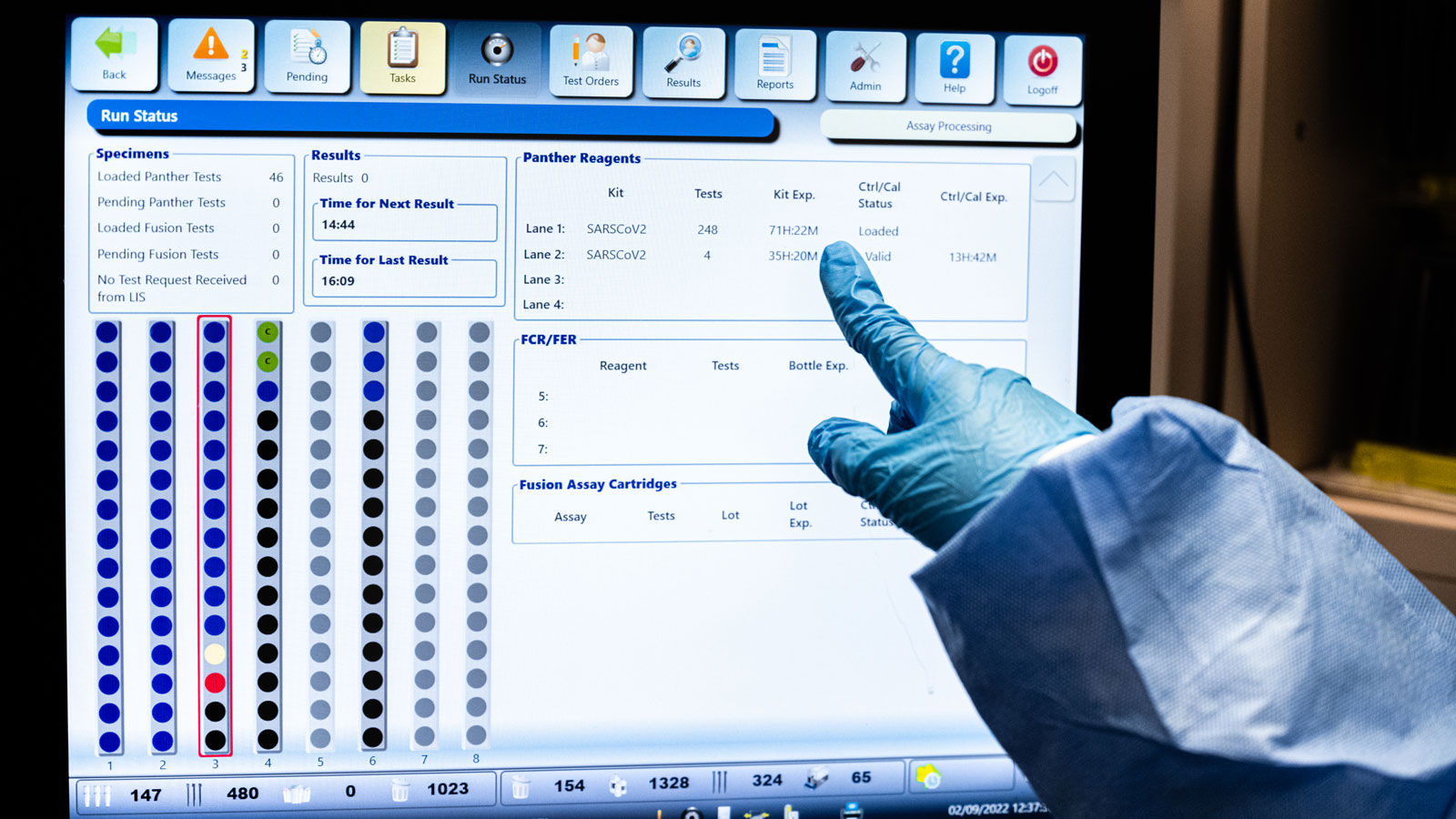
The gloved hand of Deira Ward, a medical technologist, points toward the display screen of a PCR analysis machine in the PCR testing lab at Quest Diagnostics on Feb. 9, 2022, in Indianapolis, Indiana. (Photo by Jon Cherry/Getty Images)
(Photo by Jon Cherry/Getty Images)
[plist name=”covid”][/plist]
PHOENIX – While most of Arizona’s pandemic metrics have been heading in the right direction, the state hasn’t yet seen a sustained decline in deaths from COVID-19.
Today’s #COVID19 dashboard update adds 7,379 cases and 165 deaths.
Reduce the spread: Stay home if you feel ill. Learn other ways to fight COVID-19 at https://t.co/Kd4hI8vePH. pic.twitter.com/hDrHz05g7c
— AZ Dept of Health (@AZDHS) February 10, 2022
The Arizona Department of Health Services reported 382 additional COVID deaths over the last three days, including 165 on Thursday, to push the documented total above 27,000.
According to the U.S. Centers for Disease Control and Prevention, Arizona is second only to Mississippi in COVID deaths per 100,000 residents since the agency started keeping pandemic records in January 2020.
Arizona’s seven-day average for newly reported COVID deaths was 70 for Wednesday. Outside of a 10-day spike in late January and early February, it hadn’t been that high since Dec. 28.
The current pace is sitting around the midpoint of the fluctuations seen over the last two months, a period spanning the delta and omicron waves.
Meanwhile, newly reported COVID cases, virus-related hospitalizations and the rate of positivity for diagnostic testing all are approaching or below pre-omicron levels.
Here’s the latest data on the pandemic in Arizona (hospital, case, death and testing statistics are based on Thursday morning’s update of the Arizona Department of Health Services COVID-19 dashboard; seven-day averages are based on tracking by The New York Times):
COVID-19 cases
- Documented pandemic total – 1,939,021
- Daily new reports – Thursday: 7,379; One day earlier: 5,402; One week earlier: 7,794; Pandemic high: 27,681 (Jan. 22, 2022)
- Seven-day average – Wednesday: 6,443; One day earlier: 6,861; One week earlier: 12,434; Pandemic high: 20,778 (Jan. 24, 2022)
COVID-19 deaths
- Documented pandemic total – 27,021
- Daily new reports – Thursday: 165; One day earlier: 34; One week earlier: 61; Pandemic high: 335 (Jan. 12, 2021)
- Seven-day average – Wednesday: 70; One day earlier: 68; One week earlier: 93; Pandemic high: 175 (Jan. 13, 2021)
COVID-19 hospitalizations
- COVID inpatients – Wednesday: 2,550; One day earlier: 2,568; One week earlier: 3,151; Pandemic high: 5,082 (Jan. 11, 2021)
- COVID ICU patients – Wednesday: 518; One day earlier: 528; One week earlier: 635; Pandemic high: 1,183 (Jan. 11, 2021)
Statewide hospital capacity
- Inpatients beds available – Wednesday: 588 (7% of capacity); One day earlier: 597 (7%); One week earlier: 475 (5%)
- Percentage of inpatient beds with COVID patients – Wednesday: 29%; One day earlier: 29%; One week earlier: 36%
- ICU beds available – Wednesday: 122 (7% of capacity); One day earlier: 147 (9%); One week earlier: 125 (8%)
- Percentage of ICU beds with COVID patients – Wednesday: 32%; One day earlier: 32%; One week earlier: 39%
Laboratory diagnostic testing
- Weekly percent positivity – Samples taken this week: 18%; Last week: 23%; Two weeks ago: 29%; Pandemic high (for a full week): 34% (Jan. 16-22, 2022)
- Find a testing site: ADHS (statewide)
Find a vaccine site
- ADHS (statewide); Maricopa County Public Health (metro Phoenix)
Additional details
The ADHS daily case and death updates can cover multiple days of reporting because of data processing procedures and aren’t meant to represent the actual activity over the previous 24 hours. The hospitalization numbers posted each morning are reported electronically the previous evening by hospitals across the state.
The actual caseload is likely higher than officially reported because ADHS data is based mainly on electronic laboratory reporting and doesn’t include results from home kits unless individuals report them to their health care providers.
Vaccines have proven to reduce the likelihood of a COVID infection causing serious illness or death, even with the highly contagious omicron variant. Booster shots provide additional protection and are approved for individuals who received their second Pfizer (ages 12 and up only) or Moderna doses at least five months ago or the Johnson & Johnson shot at least two months ago.
The minimum age for vaccination is 5 for Pfizer and 18 for Moderna or Johnson & Johnson.
Related
 Spotty monsoon storms could move into Phoenix area tonight
 Katie Hobbs praises John Giles running mate pick; Andy Biggs team calls him Democrat ally
 Better pay would be a start for fixing Arizona’s teacher shortage, but it’s not the only solution
 Thunderstorms outside Valley bring dust, winds to Phoenix metro area
 Police investigating homicide after man dies being detained during southeast Phoenix fight
 Motorcyclist critically hurt after crash involving car in west Phoenix

Comments
0 Comments