
After Halloween, Arizona residents mark Dia de los Muertos holiday
While some Arizonans celebrated Halloween, others began Dia de los Muertos, or Day of the Dead, a three-day celebration that runs Oct. 31 to Nov. 2.
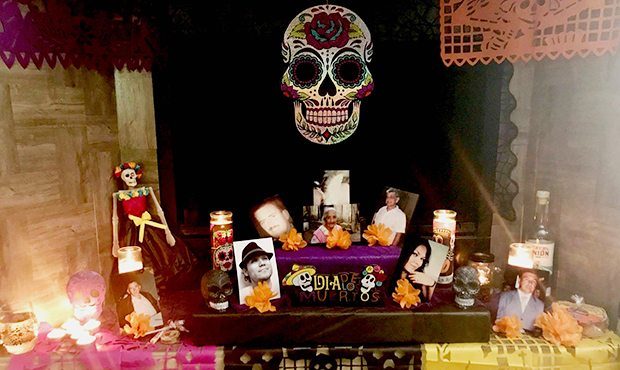
(KTAR News Photo/Griselda Zetino)
(KTAR News Photo/Griselda Zetino)
PHOENIX — While some Arizonans spent their Tuesday out trick-or-treating or scaring people, others began a three-day holiday that remembers the lives of loved ones who passed away.
Dia de los Muertos, or Day of the Dead, is a three-day celebration that runs Oct. 31 to Nov. 2. Altars to lost loved ones are a central focus of the traditionally Mexican holiday.
Altars are highly personalized. They are decorated with photos of deceased friends and family members along with offerings, or ofrendas, that represent those who’ve passed away.
“Depending on what your loved ones liked, you put stuff there that represents who they were,” Saskias Casanova, an assistant professor at Arizona State University’s School of Transborder Studies, said.
“So if your loved one was an artist, you may want to put a paintbrush, or if your loved one really liked a certain type of food or drink, you put that on the altar table.”
Altars are also adorned with a number of symbolic items including marigolds, the flower of the dead, and pan de muerto, or bread of the dead, which is bread shaped into round loaves.
Those are some of the items found on Erick Garcia’s altar. It was set up in his living room of his home in Mesa and has three levels, representing heaven, earth and the underworld.
“We tried to do it as traditional as possible,” the 31-year-old said, adding that there are more items he and his fiancé plan to add on Wednesday and Thursday.
For now, it is adorned with photos of their close friends and family members who’ve passed away. It also has candles and colorful papel picado, which is ornately cut tissue paper.
“When the tissue paper moves with the wind, that sort of tells you that your loved ones who’ve passed away are present,” Garcia said. “It signifies that they are passing through and the candles are meant to guide their way to your altar.”
He said this is the first time in more than 20 years since he has done an altar for the Day of the Dead. The last time he made one was with his grandmother in Mexico.
“I would go over to her house and it was this really special moment when family members came together to put up the altar,” he said. “There was a little bit of sadness at the beginning but then it turned into a celebration.”
When asked what drove him to do an altar this year, Garcia said it was the recent passing of his close friend, Celso Salinas-Mireles.
Casanova said altars have been a major part of the Day of the Dead since indigenous people in Mexico started the celebration thousands of years ago. After the Spanish conquest, new items were added to the altars.
“When the Spanish came to Mexico, they brought Catholicism and, in a way, they began to incorporate elements of Catholicism into the Day of the Dead celebrations,” she said.
That included adding crosses and candles to the altars, as well as establishing set dates to celebrate Day of the Dead that aligned with the Catholic holidays of All Saints’ Day and All Souls’ Day.
In essence, the three-day celebration of the Day of the Dead “is a fusion of indigenous cultures and Spanish and Catholic religion meshed into one,” Casanova said.
Related
 3 dead, 1 injured following Gilbert stabbing and officer-involved shooting
 Camelot Homes unveils boutique luxury community in Phoenix
 Dave Ramsey says: Don’t let giving turn into debt
 Construction begins on $20.1M medical office condominium development in Queen Creek
 Developer announces completion of Nexus Commerce Center industrial park in Tempe
 2 found dead after fire at home in Maricopa

Comments
0 Comments