
Legally Speaking: Breaking down the likely arguments in Joe Arpaio’s contempt case
The judge's decision in former Maricopa County Sheriff's Joe Arpaio will hinge on the prosecutorial and defense arguments. Here's a quick breakdown.
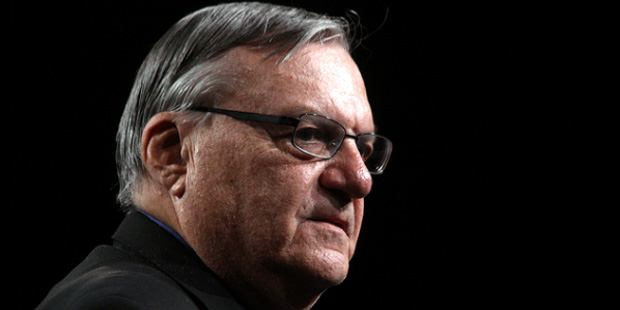
(Flickr/Gage Skidmore)
(Flickr/Gage Skidmore)
Joe Arpaio might be out of a job but he isn’t out of the legal system yet.
He is no longer the sheriff of Maricopa County but he is still dealing with the consequences of his actions while in office. Although his successor, Paul Penzone, took his place (so to speak) in the long-lasting civil case regarding racial profiling, Arpaio still faces criminal contempt charges.
His trial is scheduled to begin in late April.
A charge of criminal contempt of court requires the prosecutor prove beyond a reasonable doubt that Arpaio was aware of Judge Murray Snow’s order to cease his immigration patrols, that the order was clear and definite and that Arpaio willfully disobeyed it.
As the cornerstone of its case, the prosecutor would like to use Arpaio’s confession he made on the stand while being questioned by Snow — the proverbial “smoking gun.” However, according to court documents, the defense team claims:
- Arpaio’s confession was involuntary and he was coerced in making it
- Improper promises were made to Arpaio that led him to believe he would avoid the criminal charges
- His attorney failed to do their job and advise him that he could be criminally charged.
As such, the defense claims the smoking gun should be doused with water and then melted down. In other words, the confession should not be allowed in Arpaio’s criminal trial.
Now, you might be wondering how could the lead law enforcement officer of Maricopa County be “coerced” into confessing? How could he, who has been in law enforcement for years, not realize that he could face criminal charges if he confessed to not following a court order?
These are great questions and ones the assigned judge will want answers to.
Arpaio claims his confession in open court was the result of “psychological pressure” by Snow. In addition, since he was not allowed to leave the witness stand without the judge’s permission, he was “detained.”
Arpaio also asserts Snow “gave the impression that he was making the promise that if remedies were agreed upon in the civil matter, those remedies would extend to the criminal matter.”
Lastly, Arpaio claims his attorney never told him that he could face criminal charges.
Here is the bottom line: In order to use a confession, the prosecutor must be able to prove it was voluntary. How do you do that?
You look at the totality of the circumstances. According to Arpaio, while he was on the stand, he was pressured by the judge to confess, he was forced to stay on the stand and wasn’t free to leave, he was given false promises and his attorney failed to protect him.
Those circumstances do not paint the picture of someone who voluntarily and knowingly confessed to committing a crime.
If the criminal judge agrees, the confession will be thrown out and then the prosecutor would have to confess that his job to convict “America’s Toughest Sheriff” just became much more difficult.

Comments
16 Comments
Is it time to replace FBI Director James Comey? If so, then Joe Arpaio should be considered as the new FBI Director. There is so much corruption in the top tiers of intelligence agencies. A strong-willed, principled, law and order leader like Joe Arpaio is exactly what the FBI needs.
It is about time that our U.S. intelligence agency leaders stopped being politically correct and started following the U.S. Constitution. Sheriff Joe Arpaio will do just that. He is the furthest thing from being politically correct, that is why commenters either support him or don't.
The FBI wouldn't charge her. They only recommend whether to charge or not. And given the evidence and writing of the law, I would agree they didn't have a case. I'm sure people who have much more knowledge than the best and brightest working for the most powerful Justice Department in the world would disagree. But their opinions don't matter.
That deflector sitting in the Oval Office can still charge her, today. But again, he has reneged on yet another promise he used to dupe the rubes.
"Alinsky loving lunatics", let's see who fits that label? Former Republican Speaker of the House, Newton Leroy Gingrich used Alinsky tactics when he ran for the Republican nomination, Texas Republican Dick Armey and his Tea Party operatives actually distributed "Rules for Radicals" when they were forming the Tea Party. And Vladimir Trump used and is still using Alinsky tactics in his attempt to be president.
While the Republican's have condemned Saul Alinsky in public, privately they embrace his tactics because they work.